Frame the case.
Define the component, material, process inputs and permitted ranges. Select the output quantity and an acceptance criterion before fitting a model, so the evaluation answers an engineering question rather than only a training metric.
 PARABRAHMANTECHNOLOGIESDiscuss a project
Our first research programme connects electromagnetic and thermal modelling with machine learning. The objective: evaluate changes in an induction-heating process faster, with prediction quality assessed against independent reference cases.
Inside the approach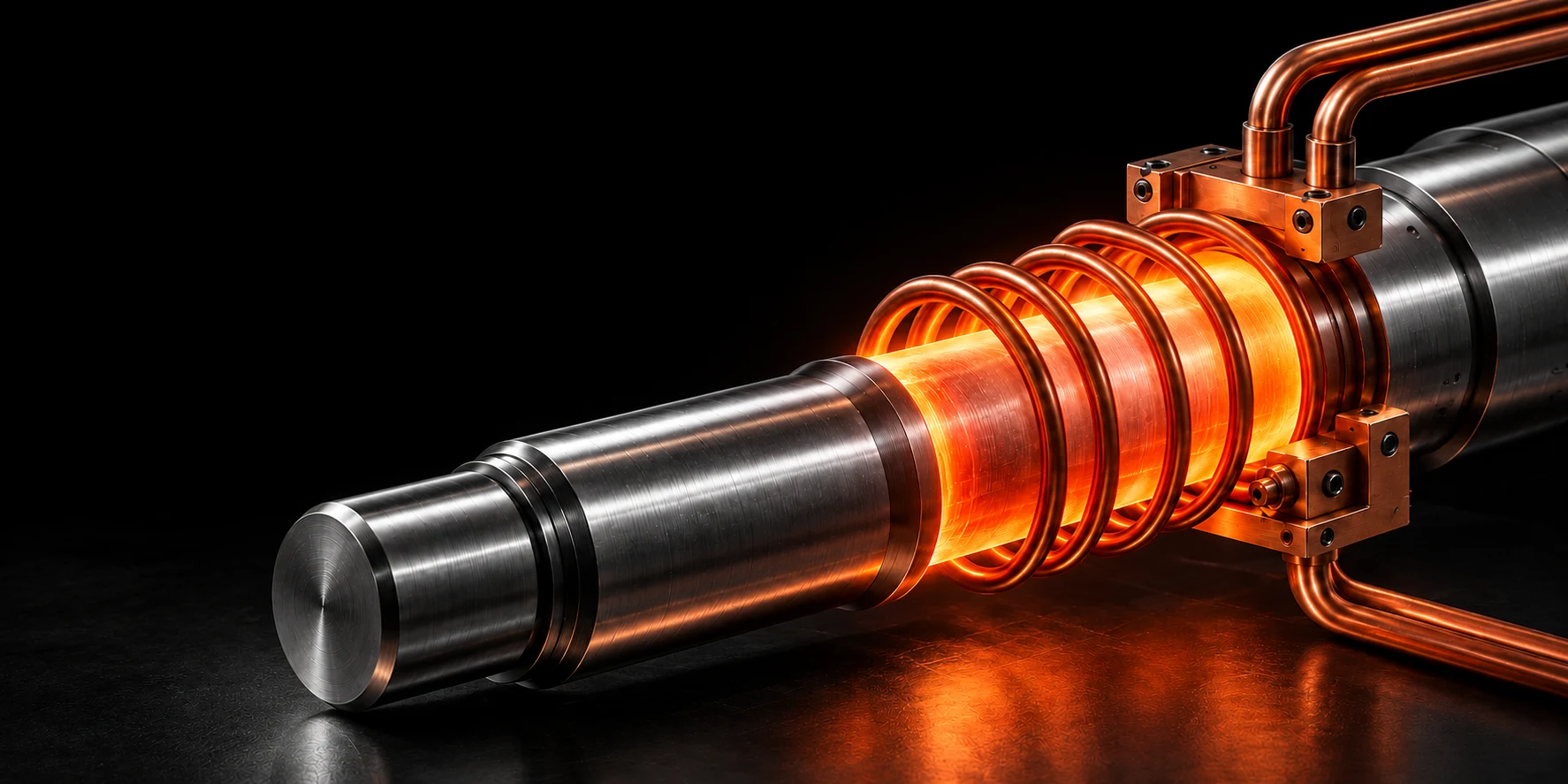
Alternating current in a coil creates a changing magnetic field, inducing currents in a conductive workpiece. Electromagnetic losses become a heat source; the resulting temperature field depends on material properties, geometry and heat transfer to the surroundings.
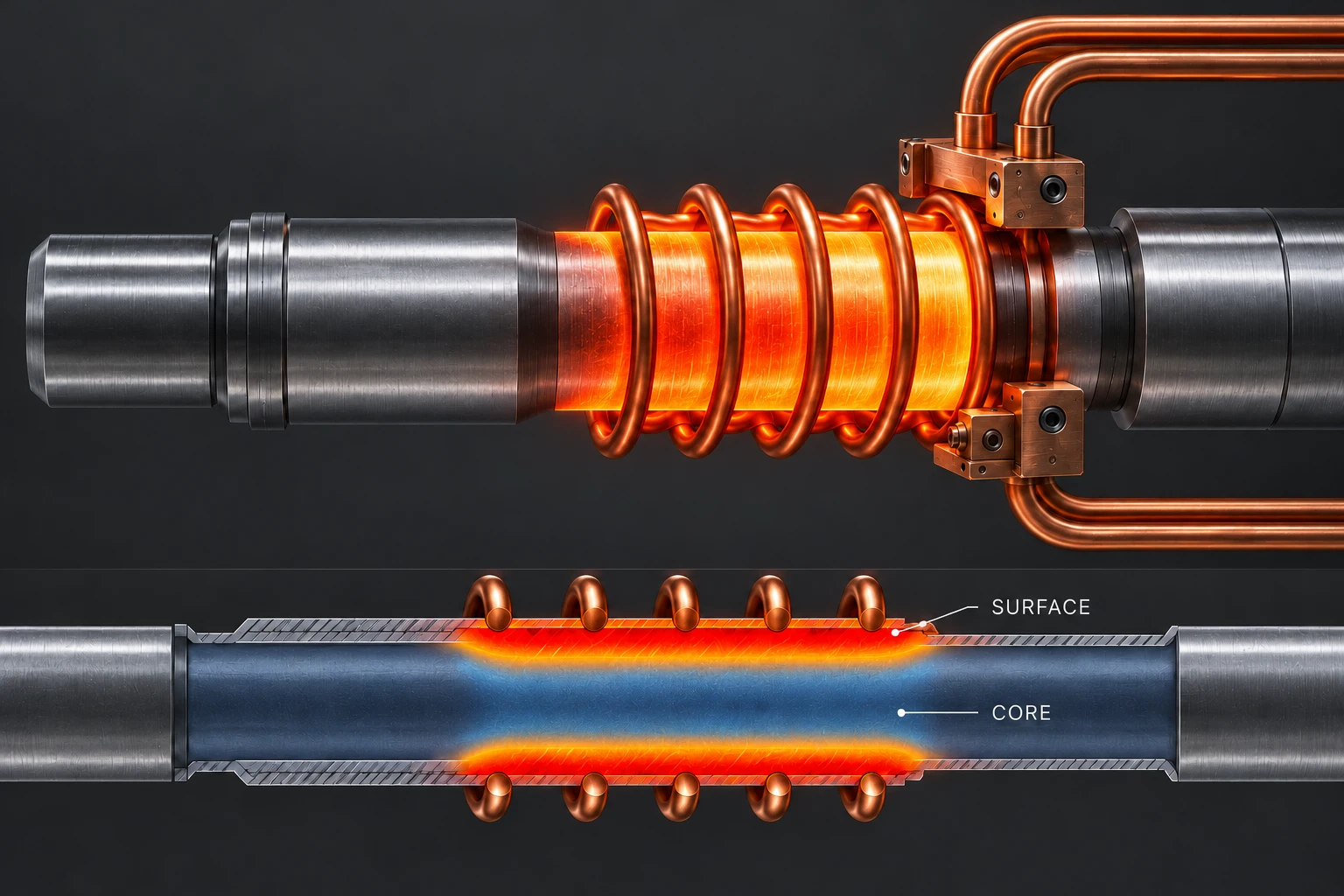
Compare physics-informed neural networks, data-trained surrogates and hybrid approaches for a specified induction-heating case. Candidate outputs include temperature at selected locations over time, surface-to-core gradients and the time required to reach a chosen thermal condition.
The intended benefit is quicker comparison of process settings once a model has been developed. Evaluation must account for reference-data generation, training cost and repeated prediction time, with error assessed against cases kept out of training and model selection.
Temperature, electromagnetic penetration and hardened depth are different quantities. Predicting a hardened layer requires a material-specific account of thermal history, phase transformation and cooling, supported by suitable metallurgical reference data.
Define the component, material, process inputs and permitted ranges. Select the output quantity and an acceptance criterion before fitting a model, so the evaluation answers an engineering question rather than only a training metric.
Establish numerical reference cases with documented mesh and time-step checks, or suitable experimental measurements. Reserve the final test cases before training and tuning. Agreement with a simulation and agreement with a physical measurement answer different validation questions.
Report error in the selected output, prediction time and the hardware used. Compare with simpler predictive baselines and the reference solver. Examine difficult cases and operating-range boundaries alongside average performance.
Induction heating provides a coupled electromagnetic and thermal problem for developing the workflow. Further applications could reuse its data organisation, model-comparison and evaluation methods; a new physical domain still requires its own equations, reference cases and acceptance criteria.
Explore computational engineering