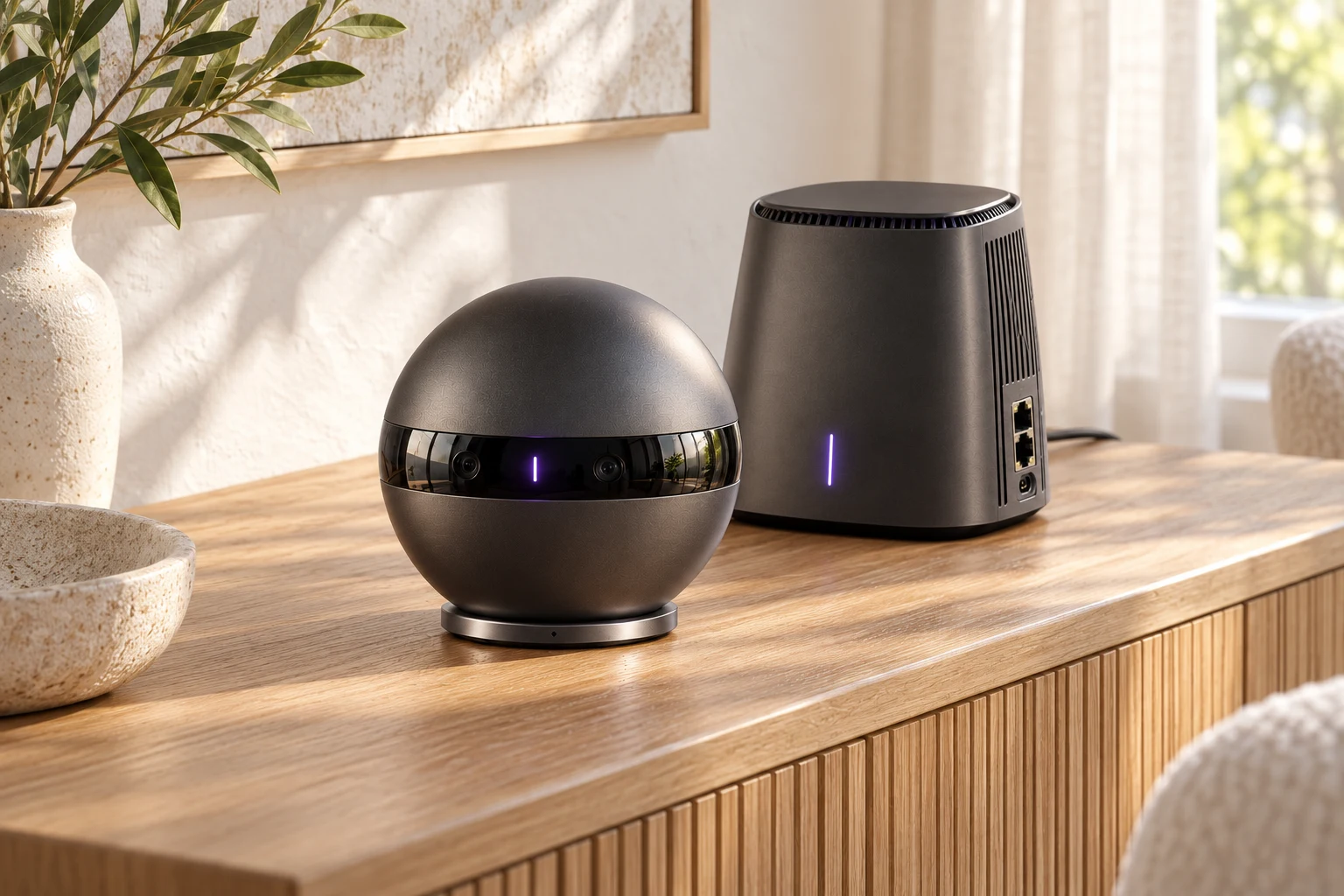
Orb concept: a graphite sphere with an optical band and subtle violet indicator beside an upright local hub.

A presence of your own.

Personal intelligence with emotional context and a locally familiar voice. Designed around your own computing hardware, private memory and continuity across the devices you authorise.

Personal intelligenceYour presence, your controlVisible rules

Personal context.
Lasting continuity.

Orb’s conversational design combines the topic being discussed, recent dialogue and preferences you explicitly share. The aim is to adapt response length, wording and pace to the interaction, with a regional accent selected by the person using it.

A home computing hub forms the centre for reasoning and personal memory. Compatible interfaces would retrieve only the context their permissions allow, so continuity between home, phone, car and workspace depends on an authorised connection rather than moving the physical sphere.

01

Emotional intelligence.

Use recent dialogue and stated preferences to adapt wording, response length and conversational pace. Evaluation should examine contextual relevance, response to corrections and whether the person finds the interaction appropriate.

02

A voice with a sense of place.

Let the person select a regional pronunciation and speaking style. Voice development needs to assess intelligibility, accent consistency and listener preference with speakers familiar with the chosen locality or region.

03

Identity before access.

Combine face, depth and voice evidence before granting personal access. Define how incomplete or conflicting checks are handled, then evaluate mistaken acceptance, mistaken rejection and resistance to impersonation under realistic conditions.

Two devices.
One intelligence.

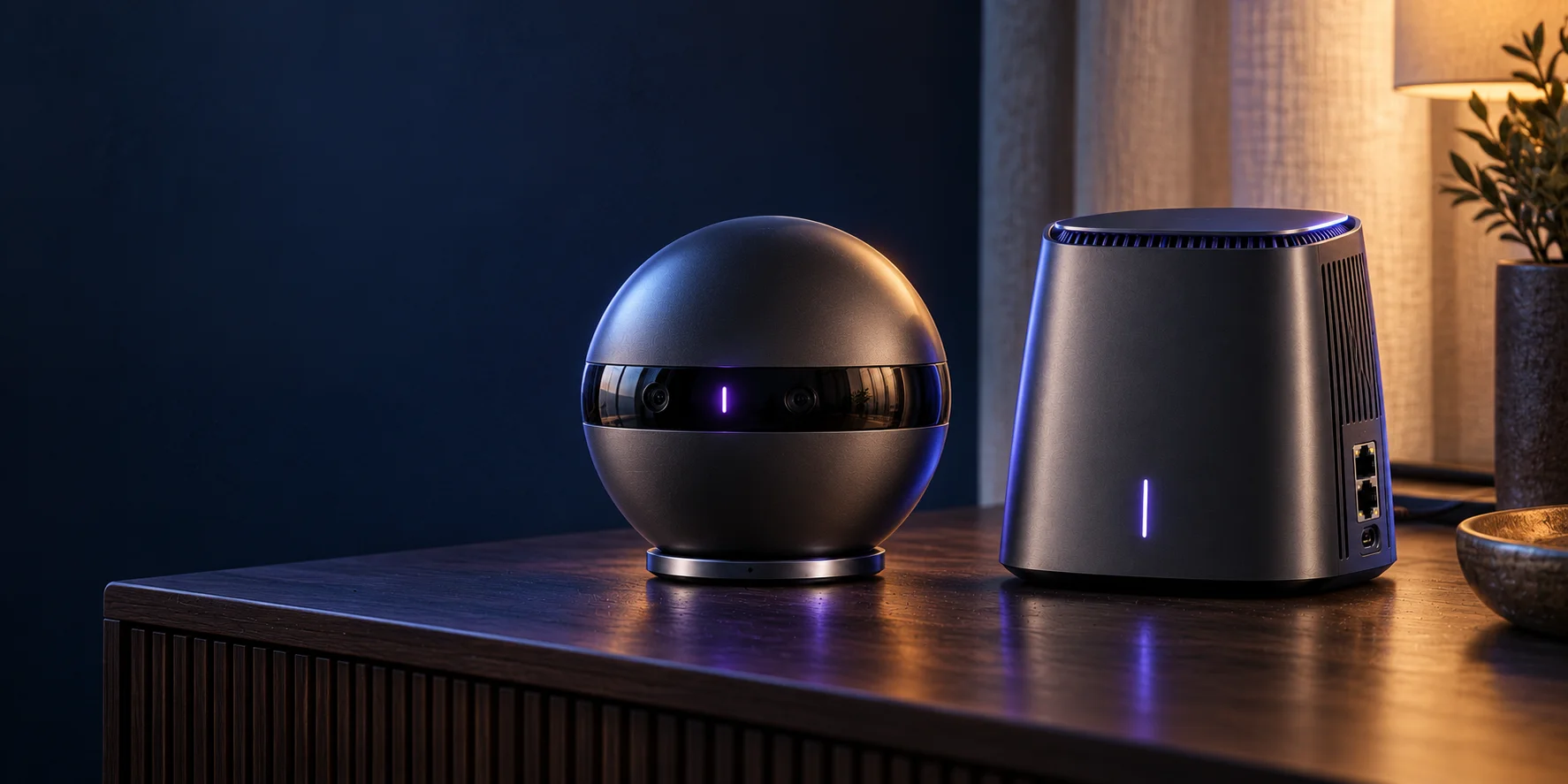
The sphere provides sensing, display and spoken interaction. A separate home computing hub is intended to run the reasoning and memory services. Compatible remote interfaces would connect back to that hub through authenticated, encrypted access, with permissions governing the context they receive.

Daylight concept of the graphite Orb sphere and router-inspired local brain on a light wood surface.

The sphere

The interaction device would capture permitted sensor input, present responses and provide physical privacy controls. Its hardware must support usable speech, visual feedback and the face, depth and voice measurements required by the access design.

  • Face, depth and voice identity checks
  • Responsive light display and spoken interaction
  • Physical controls for sensing and privacy

The local brain

The home hub would host model processing, conversation state and permission-controlled memory on hardware owned by the user. Hardware selection needs to balance response latency, power, storage and thermal demand; remote interfaces would exchange authorised requests with this hub.

  • Local reasoning and conversation processing
  • Memory separated by person and permission
  • Secure remote access from authorised interfaces

Begins at home.
Goes with you.

Keep the same preferences and permitted conversation context when moving between compatible interfaces. The sphere provides the home interaction point; remote interfaces would connect to the same home computing hub.

Each setting needs its own interface, identity checks and access policy. Remote continuity also depends on the home hub and network connection remaining available.

Choose a setting

Where the presence begins.

The sphere would send permitted interaction data to the home hub for processing. The hub would return responses and retrieve context according to the recognised person’s permissions.

A familiar assistant on the road.

A compatible vehicle interface would connect to the home hub and receive the context allowed for that journey. Interface design must account for driver attention, connectivity and which actions require confirmation.

Close, even when you are away.

An authorised phone or personal device would act as a remote interface to the home hub. Access would depend on device authentication, the current user’s permissions and a working network connection.

Work with continuity and boundaries.

A workspace interface would receive only the context authorised for that setting. The design needs explicit boundaries for personal memory, professional information and any organisation’s device or data-access rules.

Personal context.
Explicit access.

The access design combines facial appearance, depth information and voice checks. Recognition establishes who may be present; a separate permission policy determines which memories, devices and actions that person may access. Evaluation must cover both mistaken acceptance and mistaken rejection.

Evaluate conversational behaviour through how well it follows context, acknowledges corrections and adapts to stated preferences. Tone or expression can be ambiguous; when the person’s intent is uncertain, asking a relevant question is more useful than presenting an emotional inference as fact.

01

Owner

Manage registered users, device permissions and memory settings. The design gives the owner a way to inspect stored information and approve changes to household access, with additional verification for sensitive actions.

02

Family

Use an individual profile with its own preferences and permitted memory. Household rules would define shared-device access without automatically exposing another person’s private conversation history.

03

Guest

Allow a limited session without household memories or private device controls. The intended default is no persistent guest conversation memory, with any broader access requiring an explicit permission decision.

04

Unrecognised

Restrict interaction while identity checks are incomplete or inconsistent. Personal memories and privileged actions would remain unavailable until both identity and the required permission are established.

Choose a role to explore its intended boundaries.

Rules you
can read.

The proposed constitution documents access rules, memory controls, handling of uncertainty and the actions that require confirmation. It gives a person a reference for understanding and challenging the assistant’s behaviour.

Behavioural tests need to examine whether those rules hold across ordinary dialogue, conflicting requests and attempts to access another person’s information. A readable policy and evidence of enforcement are separate requirements.

01

Visible rules

Document the rules governing responses, corrections, memory and access. The person should be able to identify which rule applies to a request and how to question an unexpected result.

02

Accountable responses

Distinguish a supported answer from an estimate or unresolved question. Where a response depends on a source, assumption or user preference, make that basis understandable and allow the person to correct it.

03

Memory you can review

Provide authorised users with controls to inspect, correct and delete remembered information. Memory access should follow the person and household permissions, including a way to distinguish shared context from private records.

04

Honest perception

Treat voice, language and expression as uncertain signals. Use the person’s stated preferences and corrections to guide the interaction, and ask for clarification when an interpretation would materially affect the response.

The proposed
specification.

The design separates sensing and interaction from the hardware used for reasoning and memory. Component selection needs to account for model latency, power demand, thermal management and network behaviour alongside the sphere’s physical form.

Form
Compact sphere · <20 cm
Identity
Face, depth and voice verification
Voice
Regional accents and personal speech preferences
Interaction
Light display and voice
Compute
Dedicated local hardware · under evaluation
Connection
Encrypted local link
Privacy
Local-first operation and physical controls
Memory
Per-person, permission-based and auditable
Continuity
Home, car, mobile and work interfaces
Availability
No release date or price announced

Intelligence should belong
to the people it serves.

  • Useful assistance should strengthen human judgement.
  • Privacy should begin in the architecture.
  • People should be able to see the rules that shape an AI.
  • Memory should remain open to review, correction and deletion.
  • An intelligent presence should respect the people around it.
Orb / Sovereign by design

Worth
asking.

What does sovereign mean for Orb?

It describes intelligence built around your agency: control over personal information, visible rules and computing hardware you own. Orb begins in the home, but its presence is intended to extend to the compatible devices you authorise.

Will Orb need the cloud?

Core reasoning, perception and memory are intended to run on the local brain at home. Away from home, authorised interfaces would use a secure network connection back to that brain. Remote continuity requires connectivity; it does not move the core intelligence into a hosted AI service.

Does Orb stay in one place?

The physical sphere is a starting point. Your assistance, preferences and permitted context are intended to continue through compatible car interfaces, phones, personal devices and workspaces, connecting securely to your local brain at home. It is the digital presence that follows you; the sphere does not move by itself.

Can Orb understand emotions?

Emotional intelligence is a central design priority: adapt responses to conversation context, tone and the preferences a person shares. These signals do not establish a person’s inner state; asking and allowing correction remain part of the interaction.

Can Orb use an accent familiar to my region?

The voice design includes user-selected regional pronunciation and expression. Specific languages and accents need to be developed and evaluated for intelligibility and consistency; a locality’s name alone is not a sufficient voice specification.

How is identity checked?

Face, depth and voice are three verification layers in the access design. Their combined decision must be evaluated across lighting, viewing position, background noise and impersonation attempts. Identity recognition and permission to perform an action remain separate decisions.

When can I buy Orb?

The imagery presents a design concept, and the specifications are provisional. No release date, final hardware specification or price has been announced.

A future worth
building together.

We welcome collaboration on local inference, speech and regional accents, conversational evaluation, identity verification and device integration. A useful starting point is a defined capability, the conditions it must work in and a way to evaluate it.

Start a conversation